
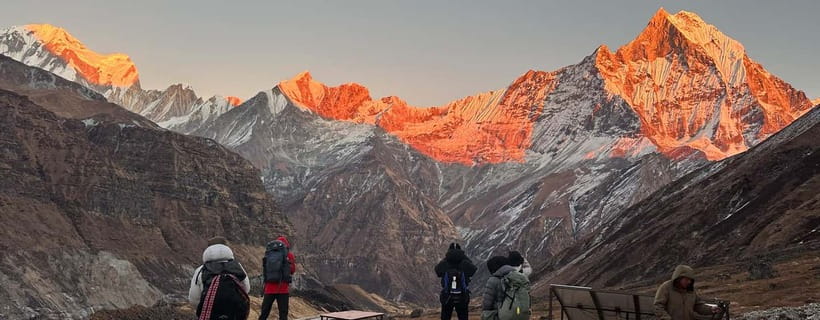
Review · HOT SPRINGS AND GEOTHERMAL POOLS
Pokhara: 7-Day Annapurna Base Camp Trek & Natural Hot Spring
The best part of this trek is the contrast: one day you’re walking through Gurung villages and rhododendron forest, and a few days later you’re inside the high, stark bowl of Annapurna Base Camp at 4,130 meters. I love that the route gives you a real Himalayan journey without requiring two weeks away from Pokhara.
I also like the natural hot spring at Jhinu Danda, which arrives at exactly the right moment after the long descent. The guides receive especially strong praise for care and encouragement. A possible drawback is the pace: six to seven hours of walking on several days, steep stone steps, and the quick rise to high altitude will test anyone who is not used to mountain trekking.
Key points to know before you book
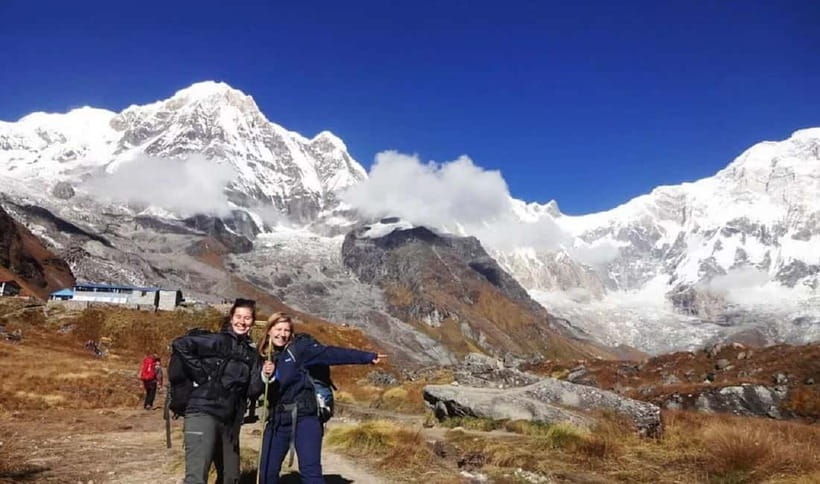
- Annapurna Base Camp reaches 4,130 meters: This is a serious mountain trek, not a casual village walk.
- The route changes scenery every day: Expect terraced fields, forests, river valleys, villages, waterfalls, and a glacier-ringed alpine basin.
- Jhinu Danda adds a welcome recovery stop: The natural hot spring is reached after the descent from Bamboo.
- Tea house lodging keeps the trip practical: You sleep in simple lodges along the route rather than camping.
- Guide quality is a major strength: Chandra, Chaundra, Bishnu Giri, Anil, Jeet Bahadur, Sun, and Laxman have been praised for safety, help, local insight, and encouragement.
- The $181 price covers the essentials: Permits, TIMS fees, transport, guide costs, lodging, and meals depending on the option selected are included.
Why this seven-day route works
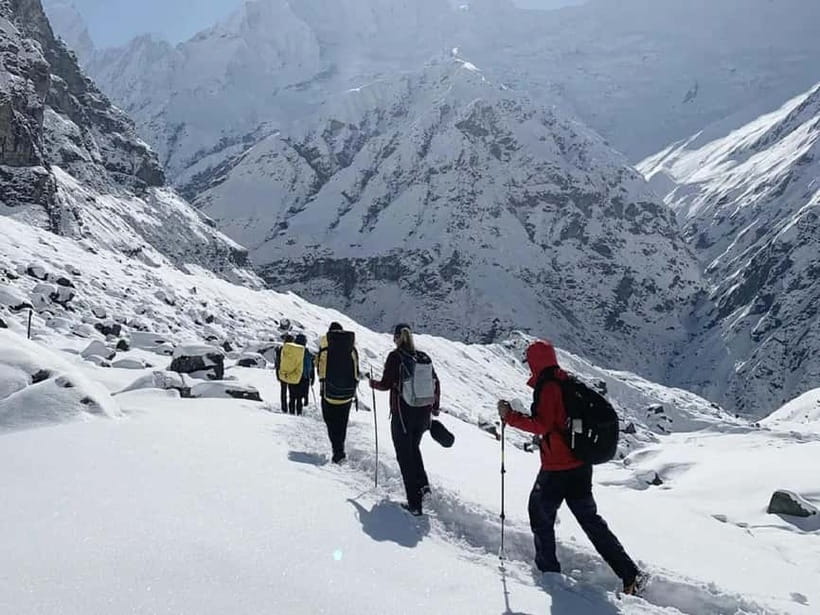
The Annapurna Base Camp trek is a compact way to reach a major Himalayan destination. You begin near Pokhara, then walk steadily from lower hills into the Annapurna Sanctuary, a mountain basin surrounded by huge peaks.
The route is not easy. You will climb and descend stone stairways, cross forest paths, and spend one night at 4,130 meters. Still, the itinerary is well shaped. The first two days let you build rhythm at moderate elevations, the middle section takes you to base camp, and the final days bring you down quickly toward warmer air and the hot springs.
I see this as a good choice if you want a short but serious Nepal trek. It suits people with reasonable fitness who can walk for several hours on consecutive days. It is less suitable if you want a gentle holiday with flexible sightseeing time.
The experience is arranged as a private group, with an English, Hindi, or Nepali-speaking guide. That matters on a route where daily conditions, energy levels, and walking speed can vary. Several guides have received special praise for looking after health and safety, helping with food, explaining mountain views, and offering encouragement when the trail became demanding.
More Hot Springs in Nepal
- Pokhara: 5 Day Annapurna Base Camp Trek & Natural Hot Spring
★ 4.9 · 44 reviews - From Pokhara: 5-Day Annapurna Basecamp Trek with Hot Springs
★ 4.9 · 26 reviews - Pkr/Kathmandu: 5-Day Annapurna Base Camp & Hot spring Trek
★ 5.0 · 6 reviews
Day 1: Pokhara to Ghandruk through the lower hills
The first day combines roughly one hour of driving with five to six hours on foot. Transport takes you from Pokhara toward Nayapool, the usual starting area for this section of the trek.
From there, the route follows the Modi Khola through villages and forest before reaching Ghandruk at 1,940 meters. Ghandruk is one of the most appealing overnight stops on the trip because it gives you an early look at village life in the Annapurna region.
This day is not simply a transfer followed by a short stroll. Five to six hours of walking makes it a proper opening day, so you should arrive with comfortable shoes and a light day pack. The route through forest and village paths introduces the rhythm of tea house trekking, where the focus is on walking, eating, resting, and getting ready for the next climb.
Ghandruk is also a useful first night for adjusting to the route. You are high enough to feel that you have left the city behind, but not yet at the elevations where altitude becomes the main concern.
Day 2: Stone steps and mountain views from Ghandruk to Chomrong
The walk to Chomrong takes about five to six hours. The trail climbs through forest and over stone steps, with views toward the Annapurna range and Machhapuchhre, the distinctive fishtail-shaped mountain.
Chomrong sits at 2,170 meters and is an important point on the approach to the sanctuary. The village marks a shift from the lower, wider valley into a more enclosed mountain route.
This is a day when pacing matters. Stone steps can feel harder than a smooth trail, especially when they continue for long stretches. Take your time and let your guide set a sensible pace. The guide’s role is not just to lead the way. It is also to watch how you are handling the altitude, keep the group together, and help turn a tiring climb into a manageable one.
The views are a clear reward. You begin to understand the scale of the mountains ahead, while the village setting keeps the trek connected to daily life in the hills. The tea houses are simple, but that simplicity is part of the appeal. You are staying close to the trail and relying on local lodges rather than a resort-style base.
Day 3: Forest trails from Chomrong to Himalaya
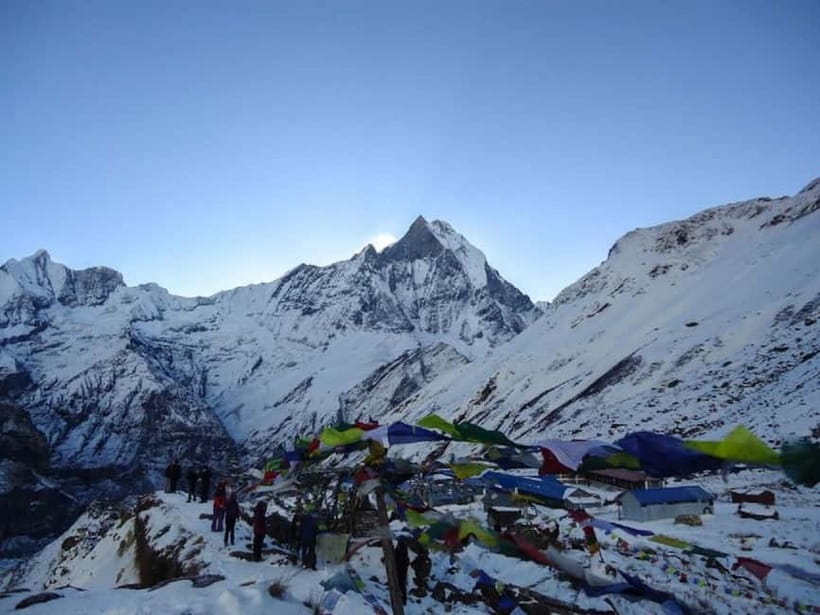
Day three covers six to seven hours and ends at Himalaya, at 2,920 meters. The route first descends toward the river, then climbs again through bamboo and rhododendron forest.
This up-and-down pattern is typical of Himalayan trekking. You may lose elevation only to gain it again, so do not judge the day by distance alone. The forest gives shade and variety, but the repeated climbs still require steady legs.
The setting becomes more enclosed as you move farther into the Modi Khola valley. Bamboo, rhododendron, and river scenery replace the broad village views of the opening days. In season, the forest can add color, though the main attraction is the sense of moving into a wilder mountain corridor.
Himalaya is a practical overnight stop before the high section. At nearly 3,000 meters, you should pay attention to your body. Drink water, eat properly, and tell your guide about unusual fatigue, headache, or other concerns. Travel insurance is mandatory, and emergency rescue services are available if needed, but sensible pacing remains your first line of protection.
More Hot Springs in the world:
- Santorini: Volcanic Islands Cruise with Hot Springs Visit
★ 4.4 · 10,869 reviews - Bali: Mount Batur Sunrise Guided Hike and Natural Hot Spring
★ 4.8 · 9,284 reviews - Reykjavik: Sky Lagoon Entrance Pass With 7-Step Spa Ritual
★ 4.8 · 6,166 reviews - Chiang Mai: Chiang Rai Temples, Karen Tribe and Hot Springs
★ 4.7 · 5,401 reviews
Day 4: Machhapuchhre Base Camp and Annapurna Base Camp
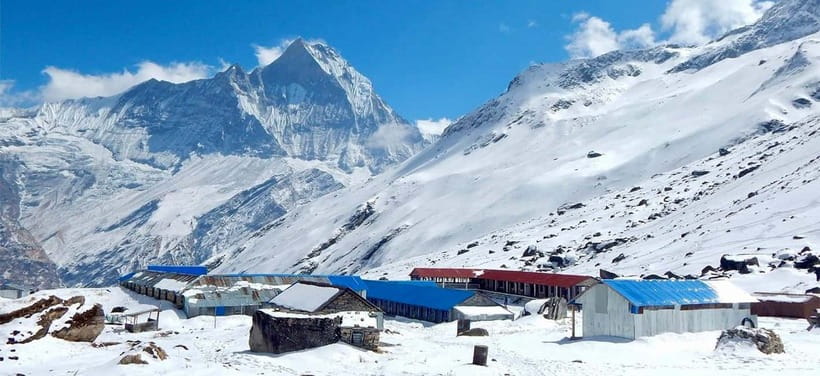
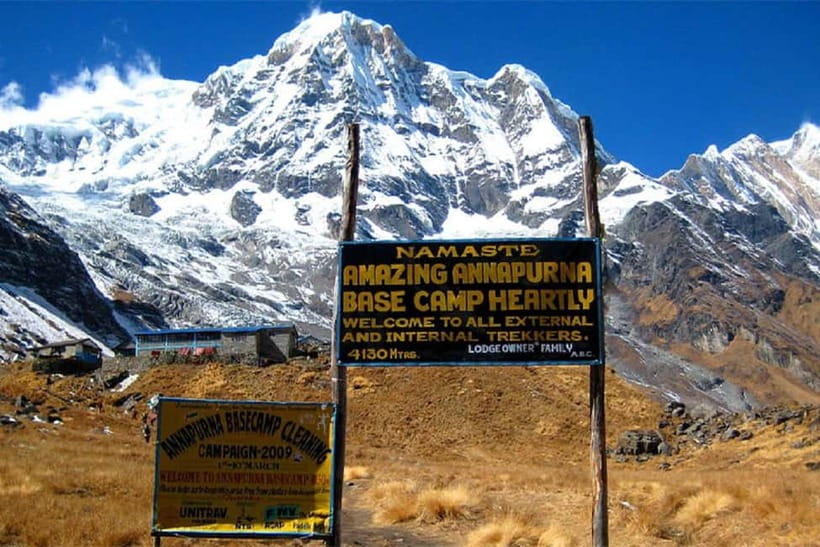
This is the main day of the trek. You walk for six to seven hours from Himalaya to Machhapuchhre Base Camp and then onward to Annapurna Base Camp at 4,130 meters.
The trail enters the alpine zone, where trees thin out and the valley opens toward glaciers and giant peaks. Machhapuchhre Base Camp is an important pause, but the goal is Annapurna Base Camp, set inside the Annapurna Sanctuary.
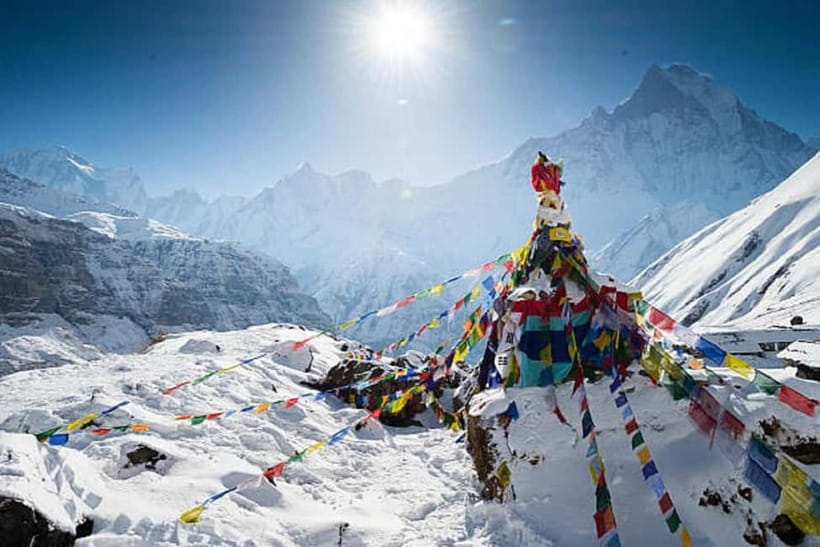
The sanctuary is the reason many people choose this route. Instead of viewing the mountains from a distant hill, you are surrounded by them in a broad high basin. Annapurna I, Machhapuchhre, and other major peaks frame the area, creating the kind of mountain setting that makes the long approach worthwhile.
You should treat this as a demanding day. The elevation is high, and the final approach can feel slow even for fit walkers. Keep your pace measured and follow your guide’s advice. The guides praised on this trip, including Bishnu Giri, Chandra, Chaundra, and others, are noted for watching health and endurance closely. That kind of attention is valuable here.
The overnight stay at base camp is also part of the experience. Tea house accommodation at 4,130 meters is basic, and conditions can be cold. Bring warm clothing, gloves, a sleeping bag if needed, a flashlight, and a power bank. The reward is the setting itself, with sunset or sunrise among the high peaks when conditions are clear.
Day 5: The long descent from base camp to Bamboo
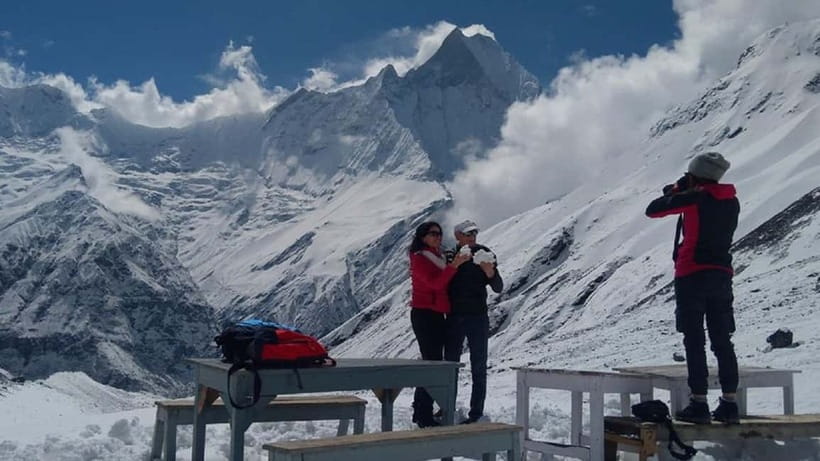
After reaching the highest point, you descend for six to seven hours to Bamboo at 2,335 meters. This is physically easier for many people because you are losing altitude, but downhill walking can be hard on knees and thighs.
The route gives you a different view of the mountains. On the way up, your attention is fixed on the next climb. On the way down, you can look back at the valley and see the peaks from a new angle. Waterfalls, forest, and changing views keep the descent from feeling like a simple retreat.
Bamboo is a lower, warmer overnight stop and a welcome change after the high camp. You may still be tired, so this is a day to use trekking poles or the supplied trekking stick if needed. A porter is not included, but one can be arranged at an additional $20 per day if carrying your own bag becomes too much.
Day 6: Bamboo to Jhinu Danda and the hot spring
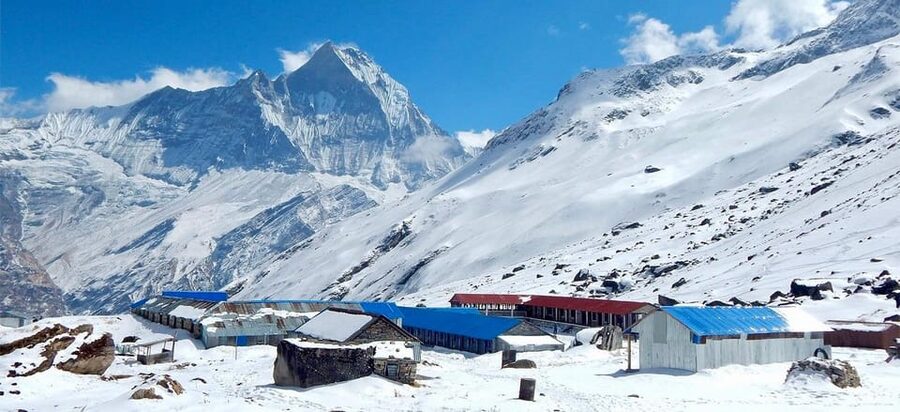
The walk from Bamboo to Jhinu Danda takes five to six hours. The route drops toward the riverside and ends at Jhinu Danda, at 1,610 meters.
The hot spring is the highlight. After several days of climbing and descending, a warm natural soak gives the trip a satisfying change of pace. Bring a towel, swimsuit if you use one, and a change of clothes. The walk to the spring is part of the stop, so do not expect to step directly from your lodge into the water.
Jhinu Danda also shows how well the itinerary balances effort and recovery. You reach base camp, come down through the forest, and then get time to relax before returning to Pokhara. It is a more rewarding finish than simply ending at a road head after the high point.
Day 7: Returning to Nayapool and Pokhara
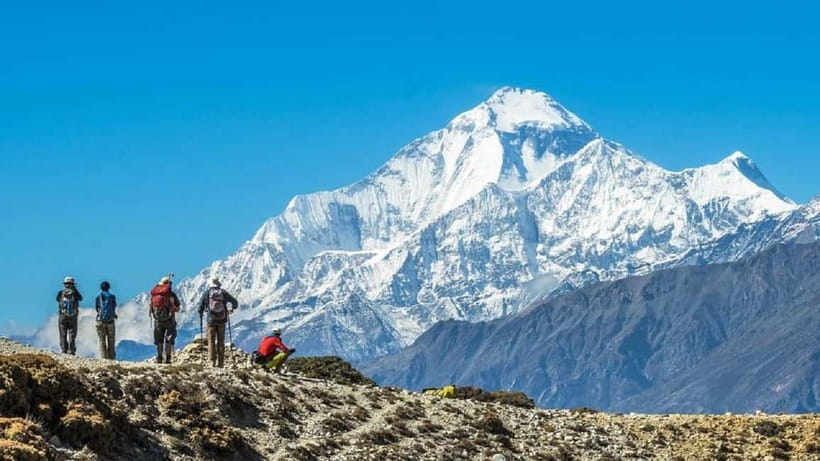
The final day includes four to five hours of trekking and about one hour of driving. You walk from Jhinu Danda toward Nayapool, then return to Pokhara by vehicle.
This section may include road walking, and that is the main practical weakness in the route. One review specifically suggested using a car or jeep for parts of the first and final days instead of walking dusty roads. Ask the operator what road and walking arrangements apply to your selected option before you start.
The final ride brings you back to the Lakeside area, Pokhara International Airport, or another listed drop-off point such as Hotel Temple Tree, Hotel Middle Path and Spa, Hotel Barahi, or Sarangkot. The exact point depends on your booking choice.
Tea houses, meals, and what the price covers
At $181 per person, this trek offers strong value if the selected option includes meals. The price covers round-trip transport connected with the trek, permits, required paperwork, TIMS fees, simple tea house or lodge accommodation, and a government-certified guide.
It also covers the guide’s meals, lodging, insurance, salary, transport, and equipment, along with government and local taxes and a first aid kit. Luggage storage in Pokhara is included, which is useful if you are carrying extra clothing or equipment for the rest of your Nepal trip.
Check the booking option carefully because meals depend on the option selected. Personal snacks and drinks are not included, so carry cash for those purchases and for other personal expenses. Travel insurance is not included and is mandatory. Emergency rescue services are available if needed, but you should have suitable coverage before setting out.
The lodging is simple. That means you should not expect hotel comforts, private facilities at every stop, or unlimited charging. It does mean you stay directly on the trekking route and spend evenings in the same kind of mountain lodges used by other walkers.
Guides who add real value
A good guide can make the difference between a hard trek that feels controlled and one that feels stressful. This trip uses a professional guide with English, Hindi, or Nepali, and the named guides who have received the strongest praise include Bishnu Giri, Chandra, Chaundra, Anil, Jeet Bahadur, Sun, and Laxman.
Bishnu Giri is especially associated with long experience, cultural stories, health checks, and practical advice at higher elevations. Chandra has been praised for strong English, mountain information, flexibility with guest house choices, and careful support. Anil helped with both walking and food, while Jeet Bahadur was remembered for a lively manner and good photographs.
You cannot assume a particular guide unless the company confirms it, but you can ask about guide assignment when booking. The private-group format also gives the guide more room to respond to your pace than a large fixed group would.
Who should book this trek?
I would recommend it to you if you want to reach Annapurna Base Camp but have only a week available from Pokhara. It is a good fit for people who enjoy long walking days, simple lodging, mountain villages, and a clear physical goal.
You should be in good health and have a reasonable fitness level. The trek includes several six to seven-hour days, steep steps, changing altitude, and one night at 4,130 meters. It is not a good choice if you want a relaxed sightseeing tour or if you are unwilling to walk in rain, cold, dust, or uneven conditions.
January can be appealing if you prefer quieter trails and tea houses. One January trek had clear skies, peaceful conditions, and fewer people on the route, though you still need proper warm clothing. Spring and autumn may offer different conditions, but the supplied information does not promise specific weather for any season.
Should you book the Annapurna Base Camp trek?
Book it if the idea of walking into a mountain sanctuary sounds better than simply looking at the Himalayas from Pokhara. The route gives you forests, villages, tea houses, serious altitude, a famous base camp, and a hot spring in one compact trip.
Think twice if you dislike basic accommodation, long walking days, or road sections at the start and finish. Also confirm whether meals are included in your selected option and ask about the guide you will receive.
At $181, the package is particularly appealing because permits, transport, guide costs, lodging, and much of the trek’s administration are already handled. For a fit walker who wants a direct route to Annapurna Base Camp with strong guide support and a relaxing final soak, this is a sensible and memorable choice.
FAQ
How high is Annapurna Base Camp on this trek?
Annapurna Base Camp is at 4,130 meters, or 13,550 feet.
How long do I walk each day?
Walking times range from about four to seven hours per day. The longest days are the routes from Chomrong to Himalaya, Himalaya to Annapurna Base Camp, and Annapurna Base Camp to Bamboo.
Is transportation from Pokhara included?
Yes. Round-trip transportation between your hotel, Pokhara International Airport, and the trek starting point is included. Pickup is available from Pokhara International Airport or hotels in the Lakeside area.
Are meals included?
Meals are included depending on the option selected. Personal snacks and beverages are not included.
Is a porter included?
No. A porter is not included, but one can be arranged if needed for $20 per day.
What language does the guide speak?
Guides are available in English, Hindi, and Nepali. The guide is certified by the Nepal Government.
More week-long stays around the world
- 7-Day TaiChi & Qigong Wellness Retreat in China
★ 5.0 · 20 reviews - 7 Days Thai Yoga Massage Training and Retreat in Begnas Nepal
★ 5.0 · 6 reviews
More walks and climbs around the world
- Mount Batur Sunrise Hike and Natural Hot Spring Option
★ 5.0 · 1,927 reviews - Private Tour Mount Batur Sunrise Trekking and Natural Hot Spring
★ 5.0 · 431 reviews - Mount Batur Sunrise Hike, Breakfast & Hot Spring
★ 5.0 · 316 reviews - National Park Hike & Finnish Smoke Sauna Experience with Campfire Lunch
★ 5.0 · 182 reviews
Newly listed around the world
- 21 Day Ayurveda & Yoga Retreat in the Himalayan country, Nepal★ 5.0 · 19 reviews
- Agadir Massage & Hammam 2 hours★ 4.5 · 53 reviews
- Luxury So Thai Spa Package (4 Hours)★ 4.5 · 18 reviews
- Dry Deep Bodywork (Dry | Thai–Shiatsu based)★ 5.0 · 45 reviews
- Hoang Spa Thai Massage★ 5.0 · 34 reviews
- Thai Massage★ 5.0 · 15 reviews
- Hue Traditional Massage For Healing, 45 mins★ 5.0 · 17 reviews
- 10 Days Ayurveda & Yoga Retreat in Kathmandu, Nepal★ 5.0 · 24 reviews
Hot Springs and Geothermal Pools, compared.
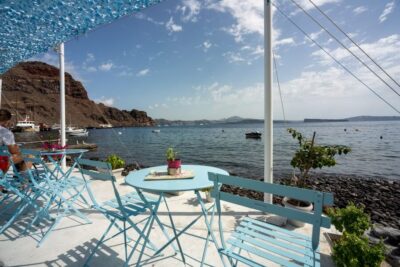
Volcanic Islands Cruise with Hot Springs Visit
Read our review →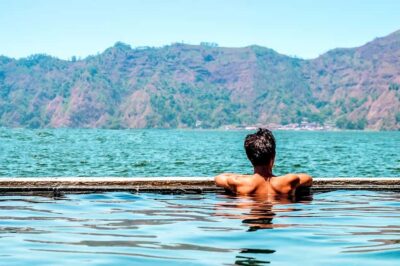
Mount Batur Sunrise Guided Hike and Natural Hot Spring
Read our review →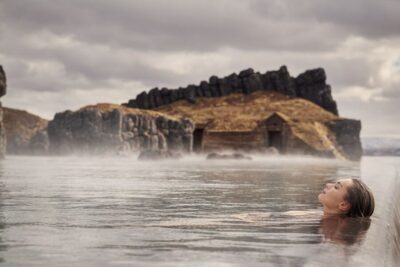
Sky Lagoon Entrance Pass With 7-Step Spa Ritual
Read our review →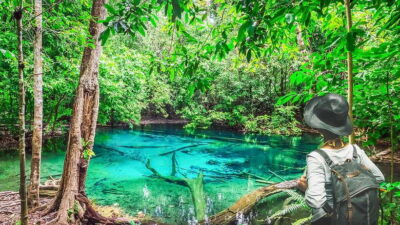
Tiger Cave Temple, Emerald Pool and Hot Springs Tour
Read our review →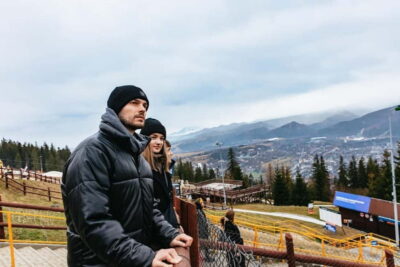
Zakopane Tour Local Tasting, Cable Car & Hot Springs
Read our review →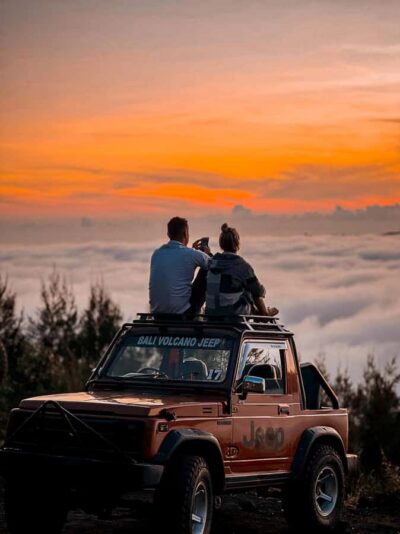
Mount Batur: Private Sunrise Jeep Tour & Hot Spring
Read our review →
Mount Batur Sunrise Hike and Natural Hot Spring Option
Read our review →
Mount Batur Shared Jeep Sunrise & Hot Spring Tour
Read our review →Browse the lists this tour appears in